
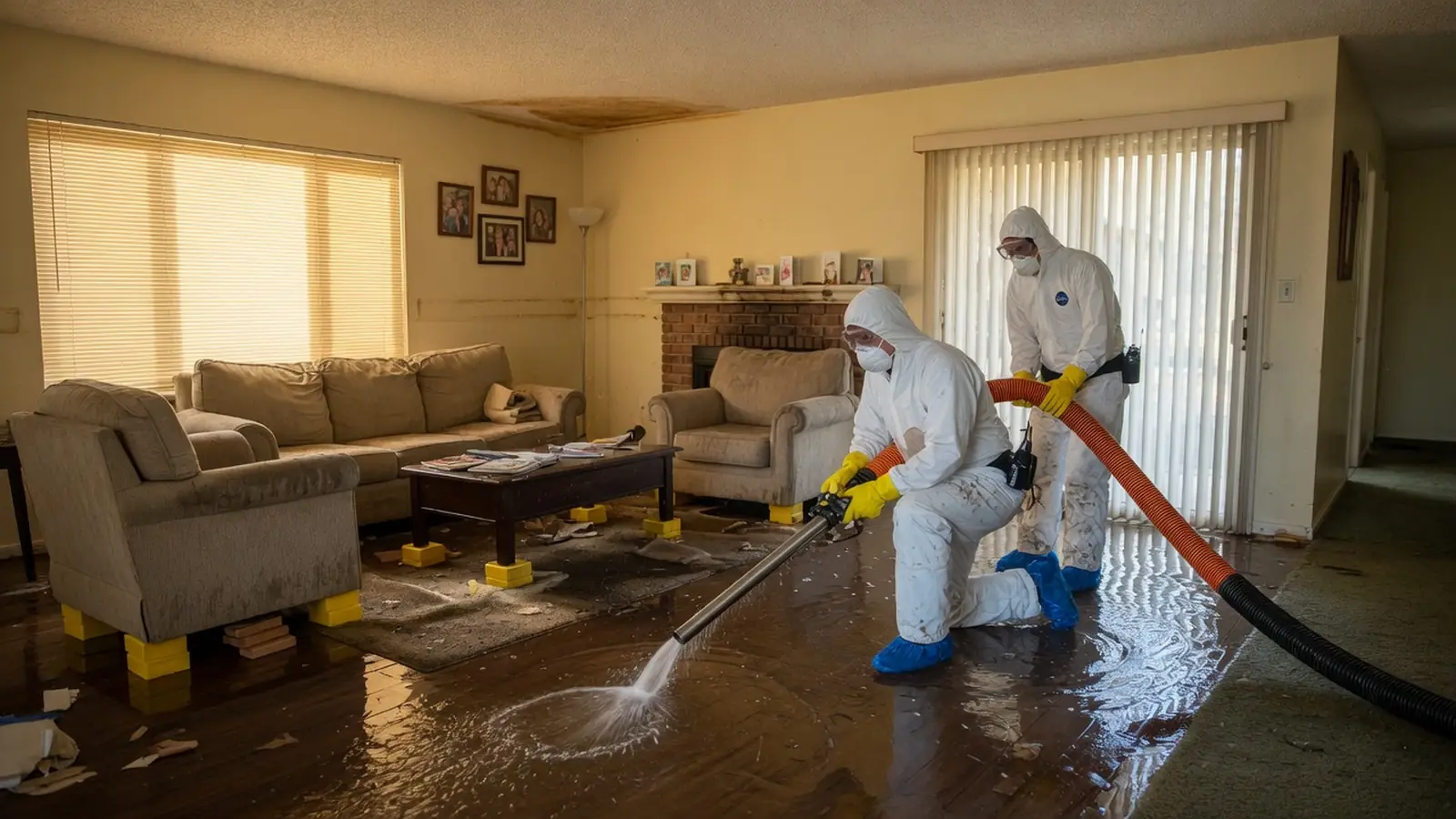
Water Damage Restoration Fort Pierce FL
Severe convective storms and tropical systems routinely drive wind-forced rain through ridge vents and soffits, saturating blown-in attic insulation before ceiling drywall collapses. NOAA radar recorded 2,074 hail signatures within about 15 miles of the city center between 2021-2025 (2021: 229, 2022: 326, 2023: 551, 2024: 570, 2025: 398). The heaviest recent hail year around the area was 2024, with 570 radar hail signatures inside a 15-mile radius, demanding immediate moisture extraction and envelope stabilization.
Water running somewhere it shouldn't? Call (772) 555-0174.
Dedicated Property Recovery Specialists
Our trade-certified specialists deliver complete structural drying and rapid moisture extraction across coastal properties.
Our certified technicians stabilize compromised properties immediately, so you can see how we manage exterior storm damage mitigation before structural rot sets in.
About 18% of housing units in the municipality (4,009 of 22,262) were built before 1960, the era of galvanized steel supply lines and cast iron drains.
About 11% of housing units (2,398 of 22,262) were built in the 1960s, overlapping the years aluminium branch wiring was installed.
About 43% of housing units (9,634 of 22,262) were built in the 1970s and 1980s, overlapping the years polybutylene supply piping was commonly installed.
About 72% of housing units (16,041 of 22,262) were built before 1980, the period when asbestos-containing materials and lead paint were still in use.
As coastal homeowners often describe in local forums, coastal residents face accelerated electrical wiring corrosion and extended structural drying timelines for masonry and framing after ocean storm surge intrusion.
We deploy industrial desiccant dehumidifiers and calibrated monitoring tools to return every affected room to baseline humidity.
Our Step-by-Step Restoration Protocol
The dominant mapped soils in the district (FL111) by acreage are Pineda sand, 0 to 2 percent slopes; Winder loamy sand; Riviera fine sand, 0 to 2 percent slopes; Nettles and Oldsmar sands. The single most extensive soil unit mapped around the area is Pineda sand, 0 to 2 percent slopes, covering about 49,408 acres of FL111, which creates high saturation zones around foundations during tropical downpours.
- Emergency Stabilization And Extraction. Storm damage mitigation begins with exterior stabilization like emergency roof tarping and window board-up to prevent recurring water intrusion while structural drying proceeds inside. Saturated drywall is mapped, and you can find out more about our containment protocols to keep airborne spores from migrating into clean rooms.
- Thermal Imaging And Moisture Mapping. Detecting hidden water trapped behind drywall and flooring requires thermal imaging and moisture meters to stop mold formation. Our crew tracks moisture pockets through wall assemblies and underneath tile or subfloor layers without unnecessary demolition.
- Selective Material Removal And Sanitization. Homeowners require immediate guidance on tear-out procedures for waterlogged baseboards, drywall, and flooring to prevent rapid mold outbreaks following hurricane flooding. We strip away unsalvageable porous elements and treat structural studs with botanical antimicrobial agents.
- Controlled Evaporative Structural Drying. High-velocity air movers and low-grain refrigerant dehumidifiers establish balanced psychrometric conditions. Technicians record daily relative humidity and moisture content readings until framing reaches dry standards.
Science-Backed Moisture Control Standards
Our commitment focuses on certified workmanship and documented restoration standards. Public discussions frequently emphasize that black water sewer backups in residential spaces create biohazard conditions requiring immediate disposal of porous contents and antimicrobial decontamination. We apply hospital-grade disinfectants and hospital-level HEPA air scrubbing on every biohazard project. Furthermore, our certified team handles complex conditions like ocean storm surge cleanup and coastal salt extraction to protect structural masonry and framing from long-term salt decay.
Burst Pipe And Plumbing Cleanup
Rapid containment and water extraction for pressurized supply line bursts and drain failures. We dry wall cavities, sanitize contaminated subfloors, and protect structural timbers from secondary rot.
Storm Flooding And Roof Leak Drying
Comprehensive emergency mitigation following severe wind-driven rain and windstorms. Our technicians extract pooled standing water, stabilize ceilings, and run industrial dehumidification equipment.
Sewage Extraction And Decontamination
Emergency category three black water removal and sanitary decontamination. We safely extract biohazards, remove non-salvageable materials, and apply antimicrobial treatments to restore sanitary safety.
Dedicated Coastal Property Restoration
We approach every water intrusion incident with clinical precision and documented verification. Our certified crews prioritize rapid water containment, thorough moisture extraction, and transparent communication throughout the drying cycle.
- 9Zip Codes Served
- 4Service Areas
- 3Services Offered
Local property owners rely on our certified restoration technicians during severe storms, plumbing emergencies, and flood events. Here is how our team delivers prompt communication, disciplined drying, and lasting results for neighborhood homes.
“When our hallway wall took on water, the technician took the time to show us why closed-cell foam insulation and moisture-resistant backing would hold up far better than standard materials. The crew saved us substantial replacement costs by preserving the structural wall studs and applying an antimicrobial sealant instead of tearing everything down. Their practical advice gave us real peace of mind.”
Marcus T.
“Severe lightning and torrential downpours shut down power across our street right after the crew set up drying equipment. The team quickly adapted by staging commercial desiccant units on mobile generator circuits to prevent any loss of drying time. They worked through the evening to get our living room fully stabilized on schedule.”
Elena R.
“Our strict community association had strict noise restrictions and staging guidelines when extraction trucks arrived at our home. The crew handled the HOA board directly, positioning their service vans discreetly and routing discharge hoses through approved access points without disturbing next-door neighbors. Everything went smoothly without a single complaint or delay.”
David K.
“Six months after our plumbing overflow, there is zero musty odor, warping, or hidden dampness in our subfloors. The team performed thorough moisture monitoring every single afternoon until every structural reading returned to baseline. Living in our home today feels completely healthy and solid.”
Brenda S.
Frequently Asked Questions
Can wet ceiling drywall and cellulose attic insulation be dried in place after a severe storm, or do they need to be removed?
Wet ceiling drywall and cellulose attic insulation must be removed rather than dried in place due to mold growth and ceiling collapse risks. Cellulose clumps and loses its fire-retardant chemicals when wet, while saturated gypsum loses structural integrity and poses an immediate falling hazard. Removing both allows technicians to decontaminate framing and dry structural joists properly.
How does local housing age impact plumbing failure and water restoration procedures?
Older regional structures built before 1980 require specialized handling because aging pipes fail easily while lead and asbestos require containment. Galvanized steel and cast iron from the pre-1960 era corrode internally, while 1970s polybutylene piping suffers sudden joint failures. Restoring these homes requires gentle containment and environmental testing before demolition.
What are the typical drying timelines for coastal flood and water damage restoration?
Standard structural drying requires three to five days using commercial air movers and dehumidifiers to return framing to baseline moisture levels. Masonry and dense hardwood framing exposed to ocean storm surge or category three black water may require additional drying days. Daily moisture meter checks verify that moisture content falls safely below critical mold thresholds.
How do soil drainage characteristics affect building foundation moisture intrusion?
Sandy coastal soils drain surface water quickly but allow high water tables to exert hydrostatic pressure against residential concrete slabs. Dominant soil series like Pineda sand experience seasonal saturation during heavy summer rains. When saturation peaks, water pushes through slab micro-fissures and foundation joints, necessitating rapid subfloor moisture extraction.
What initial mitigation steps should property owners take immediately after water damage?
Homeowners should immediately shut off the main water valve, turn off circuit breakers to damp zones, and arrange emergency professional extraction. Document all visible damage with timestamped photographs before moving unaffected valuables to dry areas. Avoid using household vacuum cleaners on standing water to eliminate electrical hazard risks.